

Types of Strainers in Industrial Applications
There are various types of strainers, each suited for different applications and operational requirements. Here is an in-depth look at the different types of strainers, their construction materials, and their unique features.
Industrial Strainers
Basket Strainers
Basket strainers, or bucket strainers, are essential for removing larger particles and debris from fluid flow. Named for their basket-like design, they use a perforated screen to capture debris, safeguarding equipment such as pumps, valves, and heat exchangers.
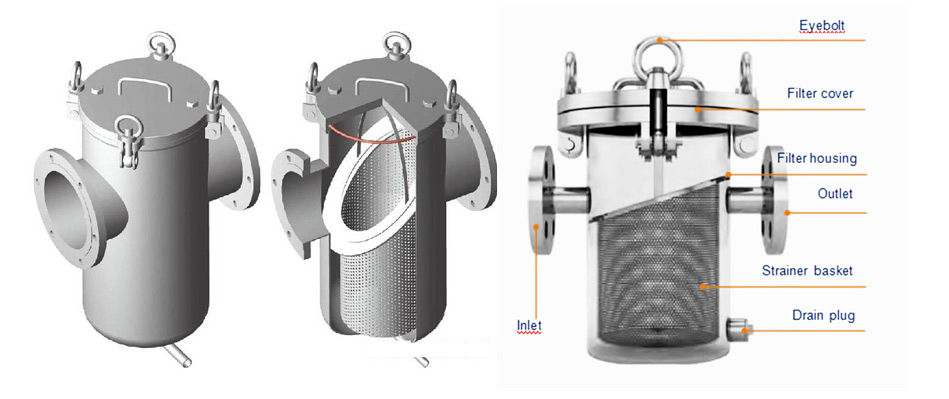
Types of Basket Strainers
- Simple Design: Requires the strainer to be taken out of service for cleaning.
- Duplex Design: Allows for online cleaning with a bypass, ensuring uninterrupted operation.
Applications
- Water treatment plants
- Chemical processing
- Oil and gas industry
- Food and beverage production
Features
- High dirt-holding capacity
- Easy maintenance with removable baskets
- Suitable for coarse filtration
Example
In a chemical processing plant, a duplex basket strainer ensures continuous operation by allowing one basket to be cleaned while the other remains in service.
Y-Strainers
Y strainers filter out solid particles from gas, liquid, or steam using a perforated or wire mesh element. Their name comes from their Y shape, suitable for both horizontal and vertical piping systems.

Characteristics
- Design: The filter leg connects to the main pipe at a diagonal angle.
- Applications: Commonly used in pressurized lines, steam, liquid, or gas, and in vacuum or suction situations.
Orientation and Installation
- Horizontal Steam/Gas: Installed horizontally to prevent water collection.
- Liquid Systems: Pocket points vertically downwards to prevent debris from being drawn back.
Features
- Higher flow rate and lower pressure drop
- Compact design suitable for limited spaces
Example
In an HVAC system, a Y strainer prevents dirt and debris from clogging coils, maintaining efficiency and extending equipment lifespan.
T-Strainers
T strainers are custom-fabricated, T-shaped devices providing efficient filtration in pipelines, handling high flow rates.

Characteristics
- Design: Can include customized features such as quick-opening covers and differential pressure taps.
- Applications: Common in industrial water systems, chemical plants, and food processing facilities.
Features
- Can handle both high and low pressure drops
- Available in various materials (stainless steel, brass, etc.)
- Effective in removing larger particles
Example
In pharmaceutical manufacturing, T strainers ensure the purity of fluids by efficiently removing large particles.
Temporary Strainers
Temporary strainers are used during startups or maintenance to protect equipment from debris. They are cost-effective solutions for short-term filtration needs.

Cone Type Strainers:
Used to remove larger debris temporarily
Truncated Cone Type Strainers:
Similar to cone strainers but with a truncated shape for specific applications.
Inline Strainers
Installed directly into the pipeline to filter out particles without disrupting the flow. Beneficial in industries like pharmaceuticals, food and beverage, and petrochemicals.
Strainer Screens
Two main types of screens are used in strainers:
Perforated Screen
- Formed by punching holes in a flat sheet, rolled into a tube.
- Suitable for removing general pipe debris.
- Hole sizes range from 0.8 mm to 3.2 mm.
Mesh Screen
- Fine wire formed into a grid or mesh, layered over a perforated screen.
- Provides much finer filtration.
- Mesh size represents the number of openings per linear inch of the screen.

Material of Construction
Common materials for strainer bodies include cast iron, bronze, carbon steel, stainless steel, and plastic.
Properties
- Cast Iron: Low cost, used for low pressure and temperature systems.
- Bronze: Preferred for brackish, saline, and seawater service.
- Carbon Steel: Suitable for high temperature and pressure conditions.
- Chrome-Moly Steel: Used for high pressures and temperatures.
- Stainless Steel: Preferred for its corrosion resistance and ease of cleaning.
Filters vs Strainers
- Filters: Remove finer particles and include disposable media.
- Strainers: Remove larger debris and can be cleaned and reused.
Conclusion
Selecting the right strainer involves considering the size and type of debris, flow rate, and pressure of the fluid. For temporary use, cone and truncated cone strainers are suitable, while for permanent use, Y strainers and basket strainers are prominent choices. Duplex basket strainers allow for uninterrupted operation during cleaning, making them ideal for critical applications.


